Tourism Club Journal | Industry Insights | September 2026
Artificial intelligence is beginning to change how travellers discover, evaluate and book hotels. As AI moves from answering questions to influencing decisions, the traditional role of online travel agencies may be entering a new phase — one in which controlling the hotel inventory is no longer enough; controlling the traveller’s decision may become the greater prize.
For more than two decades, online travel agencies transformed the way hotels reach customers. They brought thousands of properties into a single digital marketplace, allowing travellers to search, compare prices, read reviews and complete reservations without visiting individual hotel websites. The model was relatively simple: the traveller searched for a destination, compared available hotels and selected the property that appeared to offer the best combination of price, location, quality and convenience.
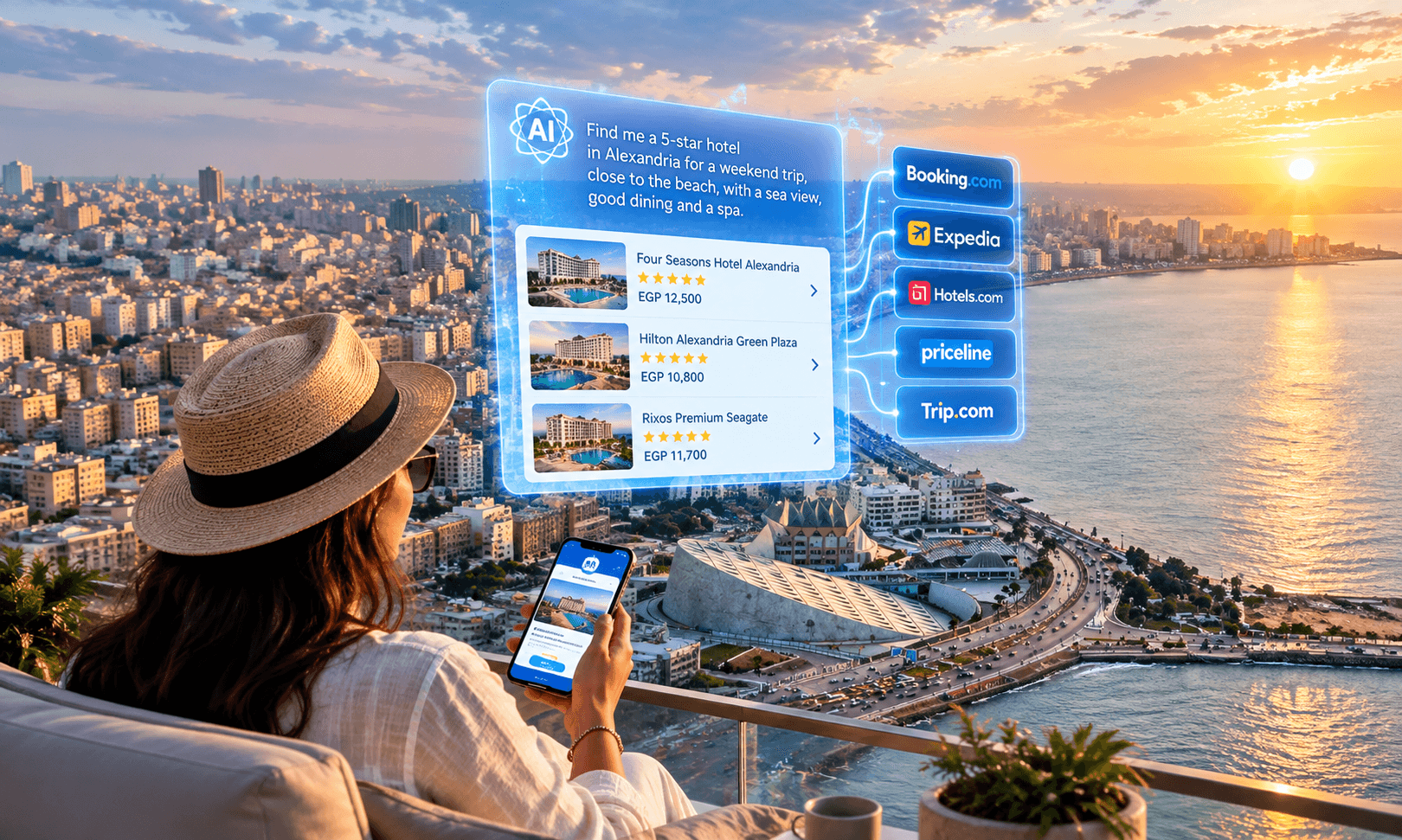
Artificial intelligence is beginning to change that sequence. Instead of searching through hundreds of hotels and deciding independently which properties deserve consideration, travellers can increasingly describe what they want in ordinary language and ask an intelligent system to interpret those requirements. The difference may appear technological, but its commercial implications are much deeper. When an AI system determines which hotels a traveller should consider, the system is no longer simply helping with search. It is participating in the decision itself.
This is already becoming visible in the strategies of the industry's largest technology companies. Google introduced hotel booking through AI Mode in the United States in August 2026, allowing users to describe their travel requirements, receive hotel recommendations, compare properties and proceed with bookings through integrated partners including Booking.com, Expedia, Hotels.com, Priceline and Trip.com, as well as major hotel groups. Google has stated that the hotel or booking platform remains responsible for the transaction and customer service. The development is important because it separates the place where the traveller makes the decision from the platform that ultimately processes the reservation.
The implications extend beyond Google. Booking.com has been integrating artificial intelligence across different stages of the customer journey, moving beyond travel inspiration toward property comparison, review interpretation and booking assistance. Expedia Group has pursued a similar direction, introducing AI-powered hotel comparison and property-assistance tools and acquiring the AI-native travel planning company Layla in 2026 as part of its broader strategy around AI-powered travel planning and booking.
The direction is becoming increasingly clear. Online travel agencies are not simply trying to make hotel search faster. They are attempting to make the decision itself more intelligent.
From Search to Recommendation
The traditional online travel agency was built around search. A traveller entered a destination, selected dates, established a price range and then received a large number of alternatives. The value of the platform came partly from its ability to organize an enormous amount of inventory and make comparison easier.
Artificial intelligence introduces a different proposition. Instead of presenting the traveller with a market to investigate, the system can interpret the traveller's requirements and reduce that market to a smaller number of recommendations.
A traveller looking for accommodation in Dubai, for example, may not simply ask for hotels below a particular price. The traveller may explain that the trip is for business, that the hotel should be quiet, close to meetings, have a strong breakfast and provide a good fitness facility. An AI system can interpret these requirements and attempt to identify properties that satisfy the overall objective rather than simply matching a collection of conventional search filters.
The search box therefore begins to resemble a decision engine.
That shift matters because the most valuable position in the booking journey may no longer be the platform displaying the largest number of hotels. It may be the system that determines which hotels the traveller actually considers.
The OTA May Move Into the Background
This does not necessarily mean that online travel agencies will disappear. In fact, the opposite may happen.
The OTA could become less visible to the traveller while becoming more important to the transaction. An AI system may become the interface through which the traveller asks questions and receives recommendations, while the OTA continues to provide accommodation inventory, pricing, payment infrastructure, reservation technology, customer support and other elements required to complete the transaction.
In such a model, the traveller might interact primarily with an AI interface without realizing how much of the underlying transaction is being powered by an OTA.
This possibility is particularly relevant to Expedia Group's business-to-business strategy. The company has been positioning its technology, travel content, pricing, payments and distribution capabilities as infrastructure that can support partners and emerging travel experiences. This suggests that the future OTA may not necessarily be the website where the traveller conducts a traditional hotel search. It could increasingly become the infrastructure behind an AI-powered travel experience.
That would represent a significant change in the economics of digital travel distribution.
The Hotel May Lose the Search Without Losing the Booking
For hotels, artificial intelligence creates both an opportunity and a new competitive challenge.
Hotels have traditionally competed for visibility on OTA search results. A property wanted to appear high in the ranking, receive strong reviews, offer competitive pricing and convert the traveller once the property appeared on the screen.
AI could introduce another layer of competition.
A hotel may increasingly need to be not only highly ranked but also highly understandable to an intelligent system. Its location, facilities, room types, policies, reviews, positioning and other information must be sufficiently clear and consistent for AI systems to interpret what makes the property relevant to a particular traveller.
This creates a potential shift from competing for search ranking to competing for recommendation.
The distinction is important. A conventional search engine can display hundreds of results. An AI system may present only a small number of recommendations based on its interpretation of the traveller's requirements.
If that happens at scale, the commercial value of being recommended could become greater than the value of simply appearing somewhere within a long list of search results.
For hotel commercial teams, digital content and data quality could therefore become increasingly connected to revenue management and distribution strategy rather than remaining primarily marketing concerns.
Trust Could Slow the Transformation
Despite the rapid development of AI, there is an important limitation: travellers may be willing to use artificial intelligence for inspiration and recommendations without being willing to give it complete control over their purchases.
Expedia Group's April 2026 research found that travellers were increasingly comfortable using AI for travel discovery and planning, but a significant majority still preferred booking through trusted travel brands rather than AI chatbots or agents. The research illustrates an important distinction between allowing AI to recommend something and allowing AI to make a transaction on the traveller's behalf.
Booking.com's global research has revealed a similar tension. Travellers expressed substantial interest in using AI during future travel planning, while relatively few were comfortable allowing AI to make decisions independently.
The distinction is critical for the hotel industry because booking accommodation is fundamentally different from asking an AI system for restaurant suggestions or travel inspiration. A hotel reservation involves money, cancellation policies, room conditions, location, customer service and the possibility that something can go wrong.
The traveller therefore needs more than intelligence. The traveller needs trust and accountability.
This gives established OTAs an important advantage.
An AI system may be capable of recommending a hotel, but the OTA can provide the infrastructure behind the transaction and, importantly, a recognizable entity that the traveller can contact when the reservation does not go according to plan.
The New Question of Customer Ownership
This creates one of the most important strategic questions for the future of hotel distribution.
Who owns the customer when an AI system recommends the hotel, an OTA processes the reservation and the hotel delivers the actual experience?
Historically, the relationship was comparatively easier to understand. The traveller searched an OTA, selected a hotel and booked through the platform. The OTA controlled an important part of the digital customer journey while the hotel controlled the physical experience.
An AI-mediated booking journey introduces another participant between the traveller and the distribution ecosystem.
The traveller may begin with an AI assistant, receive a recommendation, move to an OTA for the reservation and eventually arrive at the hotel. Each participant contributes something different, but the question of who owns the relationship becomes less straightforward.
This could become one of the defining commercial battles of the next phase of digital travel.
The battle may not be about who has the largest hotel inventory. It may be about who controls the moment when the traveller decides which hotel deserves consideration.
The Economics of Distribution Could Become More Complicated
The emergence of AI also raises questions about hotel commissions and distribution costs, although it is too early to conclude exactly how those economics will evolve.
If AI becomes a new gateway to hotel demand, hotels could find themselves operating within increasingly complex distribution chains. A traveller might discover a property through an AI interface, receive the booking option from an OTA and complete the reservation through that intermediary. Alternatively, an AI system could direct the traveller toward the hotel's own booking environment.
The important point is not that one model has already won.
It is that another technological layer is emerging between hotel supply and customer demand.
For hotels, this makes distribution strategy increasingly dependent on understanding not only where bookings occur but also where the customer's decision originates.
Data Becomes More Valuable
The strongest OTAs enter the AI era with an enormous advantage: data.
Years of searches, bookings, cancellations, reviews, customer interactions, property information and traveller behaviour provide a foundation for developing increasingly sophisticated recommendation systems.
This creates an interesting paradox.
AI could weaken the OTA's traditional position as the place where travellers search, while simultaneously increasing the value of the OTA's underlying data and distribution infrastructure.
The companies that succeed may therefore not necessarily be those that force travellers to remain inside their traditional websites. They may be those that can make their inventory, data, technology and transaction infrastructure available wherever the next generation of travel decisions takes place.
The OTA could become less visible but more deeply embedded in the travel ecosystem.
What This Means for Hotels in the Middle East
The implications are particularly relevant to the Middle East, where governments, destinations and tourism businesses are investing heavily in digital transformation and artificial intelligence.
Saudi Arabia's tourism sector is already moving toward a technology-driven model. In 2026, the Ministry of Tourism announced its AI Tourism Vision, with ambitions to deploy artificial intelligence across the visitor journey, support tourism businesses and professionals, improve service quality and increase operational productivity.
The UAE, particularly Dubai, has also invested heavily in digital tourism infrastructure, data and technology. Dubai's collaboration with Amadeus, for example, has focused on travel data, analytics, visitor journeys, marketing and other elements of a more integrated tourism ecosystem.
For hotels operating in the region, the question is therefore not simply whether they should adopt AI internally.
The more strategic question is whether they will remain visible and competitive in an environment where AI increasingly determines which properties travellers see and consider.
A hotel can have an excellent physical product and still face a digital visibility problem if its information is incomplete, inconsistent or poorly structured across the channels through which intelligent systems obtain information.
This makes digital representation part of the commercial product itself.
The OTA Is Not Disappearing
The evidence available in 2026 does not support the conclusion that artificial intelligence has made traditional online travel agencies obsolete.
Travellers continue to rely on established travel brands, and trust remains important at the point of purchase. At the same time, the largest technology and travel companies are integrating AI into the existing distribution ecosystem rather than simply replacing it.
The more realistic scenario is transformation.
The traditional OTA model was built around the idea that travellers would come to the platform to search for hotels.
The emerging model could be very different. Travellers may begin their journey somewhere else, perhaps with an AI assistant, while the OTA provides the inventory, technology, payment, servicing and transaction infrastructure behind the recommendation.
In that environment, the OTA's value may move away from simply controlling the search experience toward controlling the infrastructure that makes intelligent travel transactions possible.
The Next Battle Begins Before the Booking
The hotel booking journey has historically been built around search, comparison and selection.
Artificial intelligence is beginning to introduce another sequence: understanding the traveller's intention, interpreting the request, recommending a limited number of suitable options and then facilitating the transaction.
The traditional journey is therefore beginning to evolve from a process in which travellers search the market toward one in which intelligent systems increasingly help determine which part of the market the traveller sees.
That does not mean travellers will immediately surrender control to machines. The evidence suggests that trust, transparency and accountability will remain important.
But it does mean that the competitive battlefield is moving.
The future question may no longer be simply who has the most hotels, the lowest price or the largest marketplace.
It may increasingly be who influences the traveller before the traveller decides which hotel to book.
That is the point at which artificial intelligence becomes more than a hotel technology story.
It becomes a story about distribution, customer ownership and power across the global travel industry.
TOURISM CLUB VIEW
Artificial intelligence is unlikely to eliminate online travel agencies in the foreseeable future. A more plausible transformation is that it will change what an OTA actually is.
The OTA of the previous generation was primarily a marketplace connecting travellers with hotel inventory. The OTA of the next generation could become a combination of marketplace, intelligence layer, distribution infrastructure and trust mechanism.
For hotels, this means that direct booking strategy will remain important, but owning a website alone may no longer mean owning the customer journey.
As AI increasingly becomes an interface between travellers and hotel inventory, the most valuable position in hotel distribution may belong to whoever controls the recommendation before the booking button is ever reached.
The battle for the hotel guest may increasingly begin before the guest reaches Booking.com, Expedia or the hotel's own website — and possibly before the guest knows which hotel they want to book.