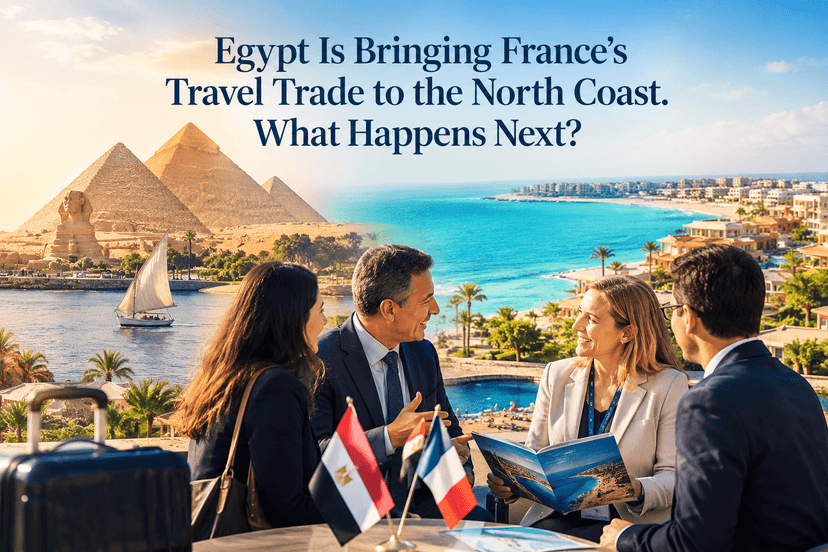
Egypt will host the annual congress of France’s travel and tourism federation, Entreprises du Voyage (EDV), on the North Coast in 2028, while delegates are expected to visit Cairo and Alexandria. With French arrivals already growing, the bigger challenge is turning a high-profile trade relationship into sustained demand, stronger connectivity, broader hotel distribution and more value from the French market.
A destination can attract attention without necessarily changing what the travel trade sells. The harder task is moving from awareness to commercial conversion, and that is what makes Egypt’s latest move in France worth watching.
During Tourism and Antiquities Minister Sherif Fathy’s meetings in Paris with Valérie Boned, president of Entreprises du Voyage (EDV), Egypt agreed to host the federation’s annual congress in 2028. The event will take place on the North Coast, with programmes also planned for participants in Cairo and Alexandria. The agreement was reached during Egypt’s participation in IFTM Top Resa 2026.
The immediate objective is clear: strengthen cooperation with the French travel industry and encourage more tourism from France to Egypt. But what would it actually take to achieve that target? The answer begins with understanding where French travel companies sit in the tourism value chain. They are not simply another source of publicity for Egypt; they influence the itineraries, accommodation choices and travel products that eventually reach the customer. Bringing those professionals to Egypt therefore creates an opportunity to move the conversation from destination promotion to product development.
From French demand to a bigger Egyptian product
Egypt already has a stronger starting point than the headline announcement might suggest. The Ministry reported a 17 percent increase in French tourist arrivals between January and July 2026, while Egypt also received the SETO Best Destination Partnership Award for 2026 following a vote among French tour operators covering around 140 destinations.
So why keep investing in the relationship if the market is already growing? Because growth in arrivals does not automatically mean growth across the full tourism economy. The more important issue is what those visitors buy, where they stay, how long they remain in the country and which Egyptian destinations benefit from their spending.
That is particularly relevant because the Ministry has indicated that French demand is gradually extending beyond the traditional focus on Luxor and Aswan toward Red Sea destinations and a wider range of Egyptian experiences. Officials have also discussed programmes combining different products, including cultural and beach tourism, while exploring opportunities to introduce destinations such as the North Coast more strongly into the French market.
This changes the question. Egypt does not simply need more French tourists; it needs to make more of Egypt commercially relevant to French travellers.
That requires the travel trade to have products it can actually sell. A destination may have attractive beaches, heritage sites and new developments, but the French operator still needs a practical itinerary, appropriate hotels, transport, air access and pricing. The real opportunity, therefore, is to reduce the gap between what Egypt offers and what the French market can easily package and distribute.
Why the North Coast matters
The choice of the North Coast gives the 2028 congress another layer of significance. Egypt has long been associated internationally with Cairo, the Nile Valley, Luxor, Aswan and Red Sea resorts. The Mediterranean coast represents a different part of the country’s tourism proposition.
But can the North Coast become an international tourism product rather than remain primarily a highly seasonal leisure destination?
That question cannot be answered through marketing alone. The destination needs connectivity, suitable hotel inventory, transport, experiences and a proposition that works for the customer and the operator. Egypt has already been linking tourism development in the area to aviation, with the Ministry highlighting the growing role of El Alamein International Airport and increasing charter activity. In its recent tourism review, the government said the North Coast had become a significant tourism development zone and noted that French visitors were beginning to incorporate it into broader programmes.
The practical test is therefore straightforward: Can a French tour operator build a profitable, attractive and operationally reliable holiday around the North Coast?
If the answer becomes yes, the significance of the congress grows considerably. The event could then serve as a live demonstration of a product that French travel companies have previously known mainly through presentations and promotional material.
Cairo and Alexandria could make the proposition easier to sell
The decision to include Cairo and Alexandria in the programme may be just as important as the North Coast itself. Why? Because international tourism is often easier to sell as an itinerary than as a collection of individual attractions.
Cairo provides the heritage and urban component. Alexandria offers a Mediterranean city experience with historical depth. The North Coast adds a contemporary leisure proposition. The combination creates the possibility of presenting Egypt through a broader journey rather than a single destination.
That matters commercially because Egypt already possesses many products; the challenge is connecting them in ways that work for international distribution. The French market appears increasingly open to different Egyptian experiences, but the next step is to determine which combinations generate actual bookings and which remain attractive only at the promotional level. Official discussions with French operators have already focused on integrated programmes that bring together different types of tourism experiences.
This is also where airlines become part of the tourism strategy. A new itinerary cannot scale without practical access, and the Ministry’s meetings in France have included discussions with airlines around links to destinations such as Hurghada, Sharm El Sheikh and Sphinx International Airport.
The implication for the industry is clear: destination marketing, aviation, hotels and travel distribution cannot operate as separate conversations if Egypt wants to convert French demand into broader tourism growth.
The hotel industry will ultimately see whether the strategy works
For Egyptian hotels, the most important question is not how many French delegates attend a conference in 2028. It is whether the French market produces additional room nights and sustainable demand.
Hotel operators will want to know whether French business is concentrated in peak periods or can help fill shoulder seasons; whether it produces longer stays; which room categories and hotel segments are performing; and whether the demand is incremental or simply replacing business from another market.
That is why the next two years matter.
Egypt can use the period before the 2028 congress to work with French operators on specific itineraries and then measure the commercial response. If new programmes are launched, airline capacity follows demand, hotels contract with operators and bookings increase, the congress will have served as part of a longer market-development strategy rather than simply as an international event.
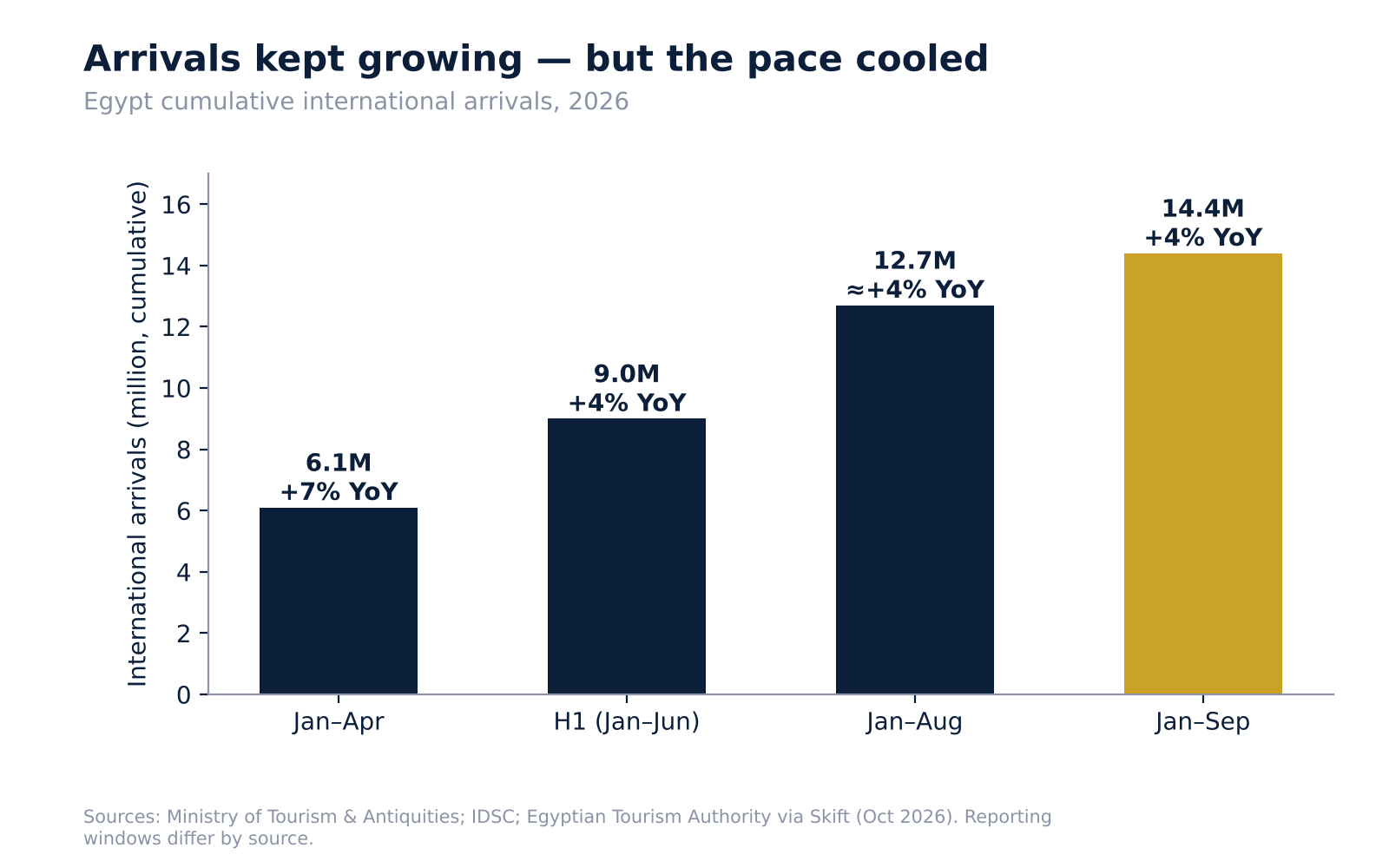
The scale of Egypt’s current tourism growth makes that approach increasingly relevant. Government data indicate that Egypt received around 12.8 million tourists between January and early September 2026, with the country targeting around 20 million visitors for the full year.
At this level of growth, the strategic question changes. The industry has to think not only about attracting additional visitors but about how demand is distributed, what products those visitors consume and how much economic value reaches hotels, airlines, tourism companies and destinations.
The real target is conversion
So, how can Egypt achieve the objective behind the EDV relationship?
The most effective approach is likely to treat the French market as a commercial development programme rather than a promotional campaign. That means using the relationship with EDV and French operators to identify products with genuine customer demand, building itineraries around them, aligning air connectivity, involving hotels and tourism companies early, and then tracking what happens after those products reach the market.
The measures should go beyond arrivals. Egypt should be able to see whether more Egyptian destinations are being added to French programmes, whether hotel room nights generated by the market are increasing, whether air connectivity is expanding, whether stays are becoming longer and whether tourism spending is rising.
Those indicators would reveal whether market interest is actually turning into tourism business.
Tourism Club View
The agreement to host the EDV congress in 2028 gives Egypt access to something valuable: the people who help turn destinations into products.
But the event itself is not the target. The real objective is to make the French travel trade more familiar with a wider Egyptian offer and then convert that familiarity into programmes, bookings and sustained demand.
Egypt already has the attractions. It is strengthening French demand. It has growing private-sector participation and an expanding aviation network.
The next challenge is commercial execution.
By the time French travel professionals arrive on the North Coast in 2028, the strongest evidence of progress should already be visible in what they are selling.
The question is no longer whether France knows Egypt. The question is whether France can be persuaded to sell more of it.
Sources
Egyptian Ministry of Tourism and Antiquities — EDV meeting and 2028 congress agreement
State Information Service — Egypt’s participation in IFTM Top Resa 2026
State Information Service — Growth in French tourist arrivals to Egypt
State Information Service — Egypt tourism sector 2025 review and North Coast development